|
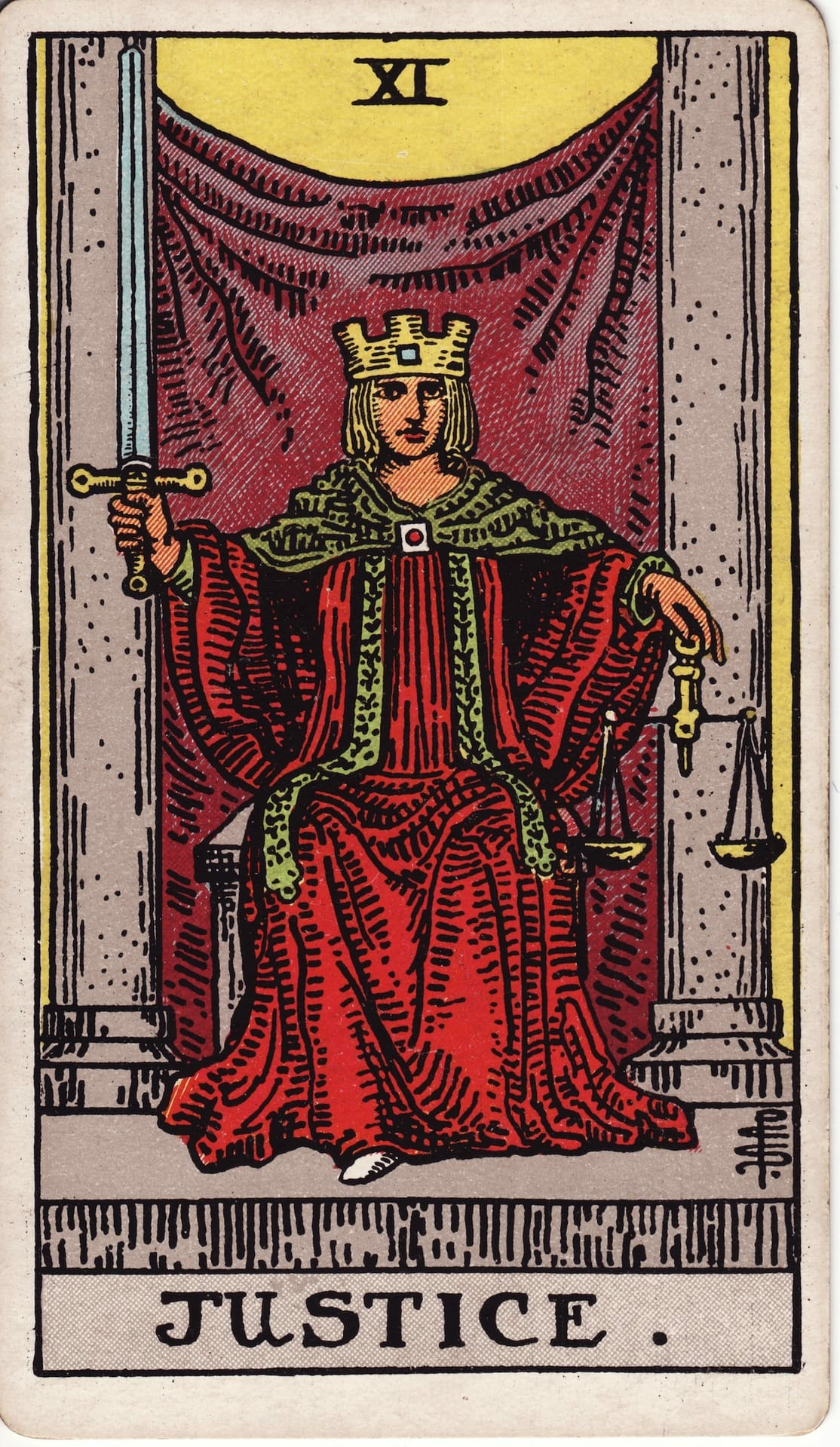
The Justice card is the eleventh numbered card (XI) of the Major Arcana in Tarot, symbolizing fairness, truth, and balance.
When The Justice card appears in the reverse, its upright qualities of fairness, balance, accountability, and truth are disrupted, blocked, or misdirected, introducing challenges or shadow aspects.
Traditional Interpretation of Justice
Justice is often depicted as a calm figure, typically a woman, gently taming a lion, with an infinity symbol above her head, symbolizing inner power and compassion. The imagery evokes resilience, gentleness, and control over primal forces. Key themes include:
-
Fairness and Justice: The Justice card signifies impartial decisions, fairness, and the pursuit of truth, often related to legal matters, ethical dilemmas, or moral judgments.
-
Balance and Equilibrium: It emphasizes restoring balance, weighing options carefully, and ensuring actions align with integrity and fairness.
-
Accountability and Consequences: The card highlights cause and effect, where actions lead to consequences, urging responsibility for choices.
-
Clarity and Truth: Justice represents clear thinking, objectivity, and uncovering truth, encouraging honest self-assessment or fair dealings with others.
-
Cautionary Note: The card warns against bias, dishonesty, or avoiding accountability, urging you to maintain integrity and avoid shortcuts that could lead to imbalance.
In a reading, The Justice card encourages you to seek fairness, make balanced decisions, and take responsibility for your actions. It’s a call to uphold truth and integrity, while ensuring you don’t become overly judgmental or rigid.
Traditional Interpretation of Justice in the reverse
When The Justice card appears in the reverse, its upright qualities of fairness, balance, accountability, and truth are disrupted, blocked, or misdirected, introducing challenges or shadow aspects.
-
Unfairness or Injustice: Justice in the reverse card suggests experiencing or perpetrating unfairness, such as biased decisions, legal setbacks, or unjust treatment.
-
Imbalance: It indicates a lack of equilibrium, where decisions or actions are skewed by emotions, bias, or external pressures, leading to disharmony.
-
Avoidance of Accountability: The card reflects dodging responsibility for actions, denying consequences, or refusing to face the truth, resulting in unresolved issues.
-
Dishonesty or Confusion: It suggests a lack of clarity, dishonesty with oneself or others, or clouded judgment, hindering fair outcomes.
-
Cautionary Note:Justice in the reverse warns against ignoring fairness, blaming others, or making biased decisions, urging you to restore integrity, seek truth, and accept responsibility.
In a reading, Justice in the reverse encourages addressing unfairness, reevaluating decisions for balance, and taking accountability to restore harmony and truth.
Alternative Interpretation of Justice
An alternative interpretation views The Justice card through an esoteric, psychological, or archetypal lens, emphasizing its spiritual and transformative significance. This perspective draws from Jungian psychology, mythology, or mystical traditions:
-
Divine Justice: Esoterically, Justice represents the universal law of karma or divine balance, aligning actions with spiritual truth and cosmic order.
-
Archetype of the Judge: The card aligns with the archetype of the divine judge, akin to figures like Ma’at or Themis, embodying impartial wisdom and the weighing of the soul’s actions for spiritual growth.
-
Inner Balance: Psychologically, Justice signifies aligning the self with personal truth, integrating conflicting desires or beliefs to achieve inner harmony and authenticity.
-
Karmic Accountability: The card reflects the soul’s responsibility to align with divine purpose, where choices resonate with universal principles, fostering spiritual evolution.
-
Shadow of Judgment: The alternative view highlights the shadow side as spiritual rigidity or self-righteousness, where excessive focus on justice disconnects from compassion or divine flow.
This interpretation might resonate in readings focused on spiritual alignment, karmic lessons, or seeking inner truth, positioning Justice as a symbol of divine balance with the need for compassion and flexibility.
Alternative Interpretation of Justice in the reverse
In a reading, the Justice card in the reverse encourages addressing unfairness, reevaluating decisions for balance, and taking accountability to restore harmony and truth.
-
Blocked Divine Justice: Justice in the reverse suggests a disconnection from universal law or karma, where fear, ego, or denial blocks alignment with spiritual truth.
-
Weakened Judge Archetype: The divine judge archetype falters, indicating difficulty embodying impartial wisdom or aligning with cosmic balance, leading to spiritual misalignment.
-
Inner Disharmony: Psychologically, it reflects a struggle to integrate personal truth, where inner conflict or denial hinders spiritual growth or authenticity.
-
Misdirected Accountability: The role of karmic accountability is disrupted, leading to actions that conflict with divine purpose or avoidance of spiritual consequences, causing stagnation.
-
Shadow of Bliss or Evasion: The shadow side may manifest as self-righteous judgment (imposing ego over divine truth) or evading spiritual responsibility (ignoring karmic lessons), obstructing soul
This interpretation might appear in readings focused on spiritual disconnection, blocked truth, or challenges in aligning with universal principles, urging reconnection with divine balance and inner integrity.
Summary (Upright)
-
Traditional: The Justice card represents fairness, balance, accountability, and truth, encouraging impartial decisions with a caution against bias or rigidity.
-
Alternative: The Justice card symbolizes divine justice, the judge archetype, inner balance, and karmic accountability, with a shadow of self-righteousness.
Summary (In the reverse)
-
Traditional meaning in the reverse: indicates unfairness, imbalance, avoidance of accountability, or dishonesty, urging restored integrity and truth.
-
Alternative meaning in the reverse: reflects blocked divine justice, weakened judge archetype, inner disharmony, or misdirected accountability, urging spiritual realignment.
|
 If you like this content, please consider supporting me through my